
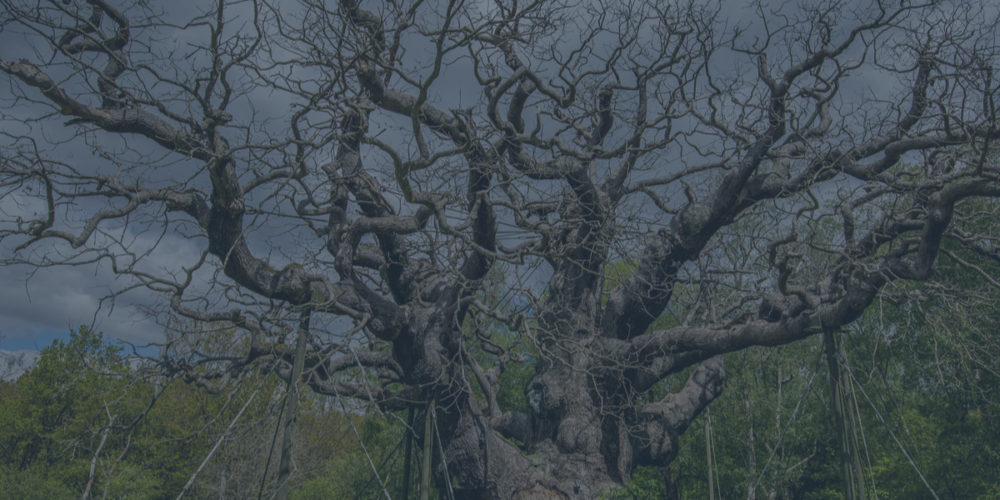
The Guardian – “Most famous tree in the world’ : Sherwood Forest’s 1,000 year old Major Oak dies”
Sky News – “World-famous Robin Hood oak tree has died”
The Telegraph – “Robin Hood’s 1,200-year-old oak tree ‘killed by sightseers”
BBC News – “Ancient ‘Robin Hood’ tree is dead, experts say”
These were the headlines that greeted me this morning. A sad and sombre moment for me. As an Environmental Science undergraduate at the University of Nottingham, we went on several field trips to the Major Oak to learn about ancient woodlands and their management. The shrinking of the wider Sherwood forest is well documented, from its ecological peak in the 17th century covering 100,000 acres to its current state of 1,400 acres. But the ‘passing’ of such an iconic tree felt different.
We know that oak trees can take several centuries to reach full maturity, with the Major Oak itself having reached maturity by the 1600s. This was possible due to the largely undisturbed ecology surrounding the tree, where healthy soils, mycorrhizal networks and expansive root systems supported its growth. Since then, however, its story has been one of slow but visible decline.
The Major Oak rose to prominence in 1790 when Major Hayman Rooke featured the tree in his writings on Sherwood Forest’s ancient oaks. Increased awareness inevitably brought increased visitors, and over the following centuries millions travelled to see one of Britain’s most famous trees. While this popularity helped secure its place in the national consciousness, it also had consequences. Repeated footfall gradually compacted the sandy soils surrounding the tree, reducing the flow of oxygen, water and nutrients through the root zone and placing increasing pressure on an ecosystem that had evolved over centuries.
This decline appears to be the result of centuries of human influence interacting with natural ageing and more recent climate pressures. In recent years, the area has experienced several successive periods of drought and exceptionally warm summers. For a tree already weakened by poor root health and soil compaction, these conditions represented an additional challenge. Ancient oaks are remarkably resilient and, in the right conditions, can survive for many centuries. However, they remain dependent on healthy soils and stable environmental conditions. The evidence suggests that human activity played a significant role in weakening the environmental conditions upon which the Major Oak depended. Added to this, some historic conservation measures, including branch supports and cavity filling, are now understood to have had unintended consequences for the tree’s long-term health.
What does this mean for the UK’s ancient trees?
While much of the focus has understandably been on the death of a single tree, the bigger question is what this means for the thousands of veteran and ancient trees across the UK.
The UK contains one of the highest concentrations of ancient oak trees in Europe. Many have survived for centuries through wars, industrialisation, agricultural change and urban expansion. Yet the pressures they now face are increasingly complex. Climate projections suggest hotter summers, more frequent heatwaves and greater variability in rainfall. For trees already challenged by fragmented habitats, soil degradation and development pressures, these changing conditions may reduce their ability to recover from environmental stress.
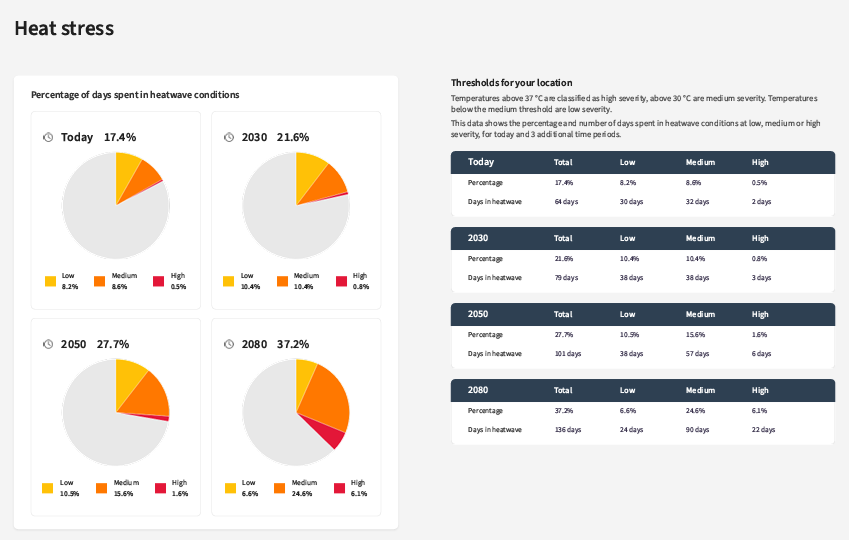
Running a Landmark Climate Change report on the Major Oak site illustrates the scale of this challenge. Heat stress projections show a significant increase in the frequency of hot weather conditions over the coming decades. The number of days classified within heatwave conditions is projected to increase substantially, with medium and high severity heat events becoming increasingly common. By 2080, the site could experience around 90 days per year in medium-severity heatwave conditions, compared to approximately 32 days today.
Surface water risk was also identified within the climate assessment, increasing from Moderate today to Moderate to High by 2050. This highlights an often-overlooked aspect of climate change; it is not simply a story of hotter, drier summers. Rather, climate projections point towards greater variability, with periods of drought punctuated by intense rainfall events. For ancient trees, these extremes can be particularly challenging, especially where historic soil compaction has already restricted the movement of water, oxygen and nutrients through the root zone.
Perhaps the most important lesson from the Major Oak is that resilience should never be taken for granted. A tree that survived more than a millennium of history was ultimately vulnerable to the cumulative impacts of environmental change. Although the Major Oak has reached the end of its life as a living tree, its legacy should encourage renewed focus on protecting the soils, habitats and climatic conditions that will allow the next generation of ancient trees to emerge.
Beyond the eye-catching headlines there was one that most people probably missed:
“The Major Oak: A new chapter for a legend of Sherwood Forest” – The RSPB
As the tree fails to produce leaves, its role in the ecosystem is changing rather than ending. Standing deadwood is one of the most valuable habitats in an ancient woodland, supporting fungi, insects, birds and countless other species. The story of the Major Oak is therefore not over; it is simply entering another chapter.